

Review of AORUS NVMe Gen4 2TB SSD with X570 AORUS XTREME
OCWorkbench 7 Jul 2019
Introduction
Gigabyte AORUS has come a long way. From motherboards to accessories and SSD. In conjunction with AMD’s PCIe 4.0 Ryzen 3000 series, AORUS introduces the world’s first PCIe 4.0×4 Controller, Phison PS5016-E16 controller, made by 28nm manufacturing technology.
Although it spots a PCIe 4.0×4 interface, the M.2 2280 can be slotted into PCIe 3.0 capable motherboard e.g. X370 chipset or upcoming newer X570 motherboard.


It has 2 TB of capacity which is suitable as a fast storage for multimedia users who needs fast and large space for video editing.
In addition, the NVMe 1.3 protocol, LDPC error correction, and Wear Leveling, Over-Provision technologies to improve reliability and durability of SSDs.

- Form Factor: M.2 2280
- Interface: PCI-Express 4.0×4, NVMe 1.3
- Total Capacity: 2000GB*
- Sequential Read Speed : up to 5000 MB/s**
- Sequential Write speed : up to 4400 MB/s**
- Wear Leveling, Over-Provision technologies
- TRIM & S.M.A.R.T supported
- Fully Body Copper Heat Spreader
- Warranty: Limited 5-years
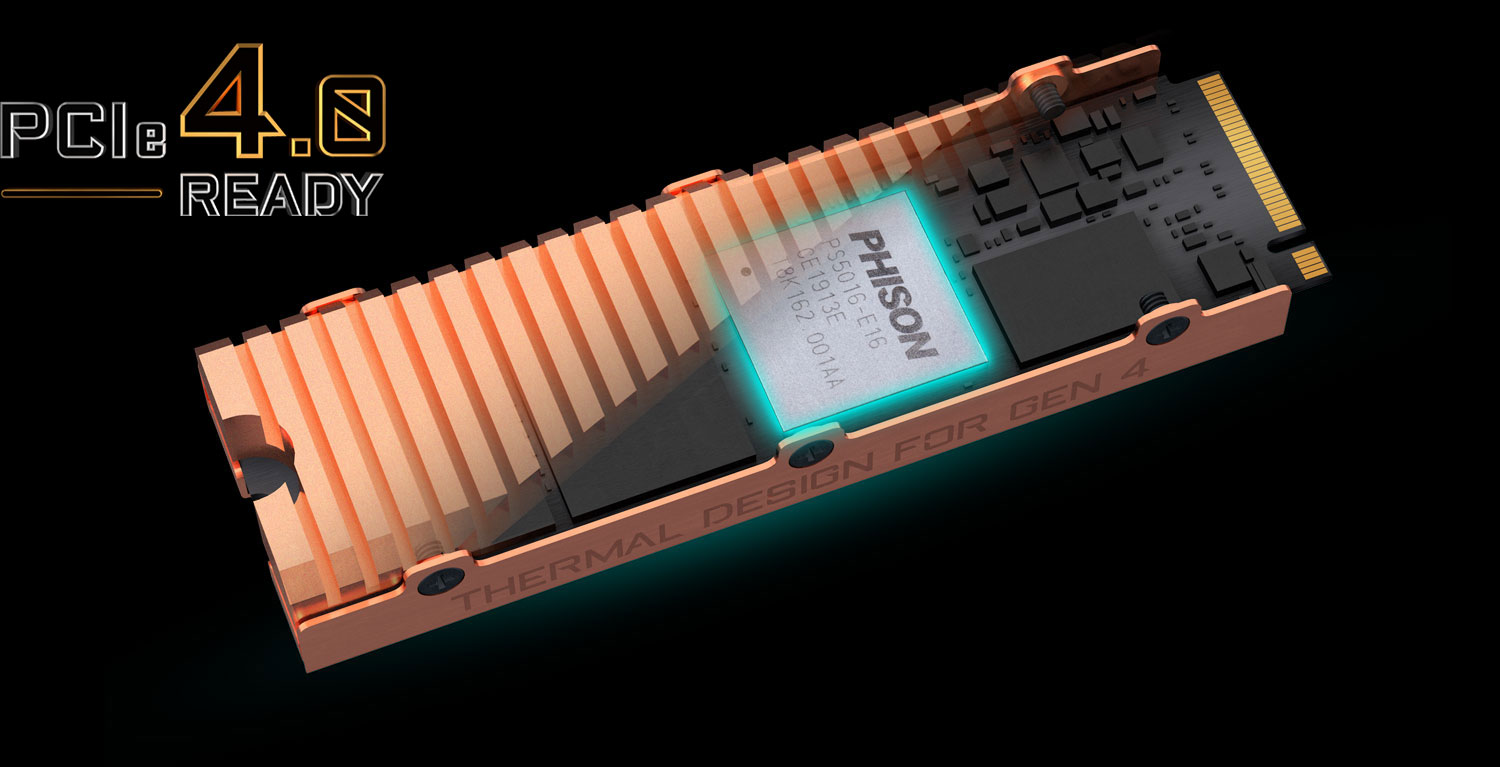
- PCIe 4.0×4, NVMe 1.3 Interface
- DDR4 DRAM cache
- 8 CH with 32 CEs
- Phison 4th Gen LDPC & RAID ECC
- Support Pyrite
- Heat spreader for controller
[nextpage title=”Performance comparison of running under PCIe 3.0 vs PCIe 4.0″]Performance of running it under PCIe 3.0 vs PCIe 4.0
In this test, we tested the device on a AORUS AX370 Gaming5 and a X570 AORUS XTREME motherboard. The AX370 Gaming 5 was paired with a Ryzen 7 1800X while the X570 AORUS XTREME was paired with a Ryzen 5 3600X.
The AORUS AX370Gaming 5 is an older chipset which supports the Ryzen 1000/2000 series processor. The X570 AORUS XTREME is based on the AMD X570 chipset supporting PCIe 4.0.
As you have guessed, PCIe 4.0 doubles the bandwidth of the PCIe 3.0 theoretically In practical, a PCIe 4.0 x16 slot can theoretically hit approximately 32 gigabytes per second (GB/s) of data flowing in each direction, while PCIe 3.0 maxed out around, you guessed it, 16GB/s.
So, let’s check out the performance of the NVme under PCIe 3.0 vs PCIe 4.0.
CrystalDiskMark Benchmark
It can be clearly seen that the Sequential read and write reaches almost 5000 MB/s and 4300 MB/s for read and write respectively. Even in 4KQ1T1 random read/write, we see an improvement of PCIe 4.0 vs PCIe 3.0.
Sequential read increase of 39% (read) , 22% (write). As for random read/write, the performance jump is as high as 80.5% (read) 162 % (write) for 4KBQ1T1 test.


[nextpage title=”Sisoft Sandra Benchmarks”]
SiSoft Sandra File System Bandwidth test
Next, we test out the drive using the two boards and processors to find out the differences in performance using SISoft Sandra.
The PCIe 3.0 platforms get a result of 2.73 GB/s vs 3.16 GB/s on the PCIe 4.0 platform. A gain of 15% in file system bandwidth.


[nextpage title=”SiSoft Sandra 2018 File System I/O performance”]
SiSoft Sandra File System I/O test
The PCIe 3.0 platform scores 35.9 kIOPS vs PCIe 4.0 at 44.3 kIOPS. The increase is about 23.3%.


Conclusion
There is no doubt PCIe 4.0 does improve the overall performance of NVme access over PCIe 4.0. Although it is good to have that boost in speed, you will need to upgrade both the motherboard and processor to take advantage of PCIe 4.0.
Current AMD motherboards will work with the AORUS NVme but at a lower speed.
I highly recommend this NVme to users who require video encoding as it is very speedy irregardless of whether you are using a PCIe 3.0 or PCIe 4.0 (way better speeds).
Pricing Info
