
POCO, as we already know it similar to Redmi, a sub brand of Xiaomi which focuses on the entry to mid range level smartphone that don’t break your piggy bank.
Today, we are going to take a look this newly launched POCO M3 Pro 5G. This smartphone is based on the new entry level 5G chipset from Mediatek – Dimensity 700. Surprisingly, this phone marks almost full resemblance in specs to the Redmi Note 10 5G.

MediaTek Dimensity 700 and its leading 7nm process offer flagship–level experience and power efficiency. This octa–core CPU operates at up to 2.2GHz, and fast UFS 2.2 storage supports power users with high performance when streaming videos, playing games, or snapping pictures. Supporting all this power is a large 5,000mAh (typ) battery that can last up to 2+ days**. The device also comes with a 22.5W in-box charger and supports 18W fast charging. Meanwhile, the Dual 5G SIM gives you 5G that’s always on.
The phone comes in two configurations : 4+64 GB or 6+128GB and runs on Android 11 MIUI 12. It has a 6.5″ FHD + LCD DotDisplay at 90 Hz. It comes with a 5000mAh battery with 18W fast charge (In box charged included is a 22.5W)
At the back of the phone are 2 cameras and on the front is a selfie camera.

48 MP 1/2″ sensor 1.6um 4 in 1 super pixel at f/1.79
2 MP macro camera at f/2.4 with 2 MP depth sensor
8MP f/2.0 front camera
In terms of connecivity, it supports 2.4GHz/5GHz WIFI, a 3.5mm headphone jack, Multi-functional NFC, Bluetooth 5.1 • IR Blaster & FM radio (with headphones).
So, for all these functionalities it’s asking price is merely S$339 (was S$269 when launched). What kind of performance do we get ? Does it overheat ? Read on to find out.
[nextpage title=”Benchmarks”]
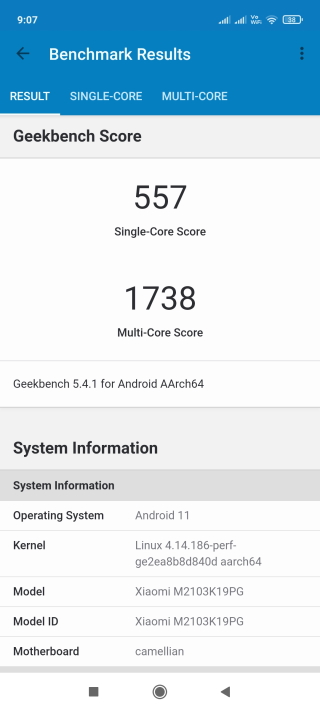
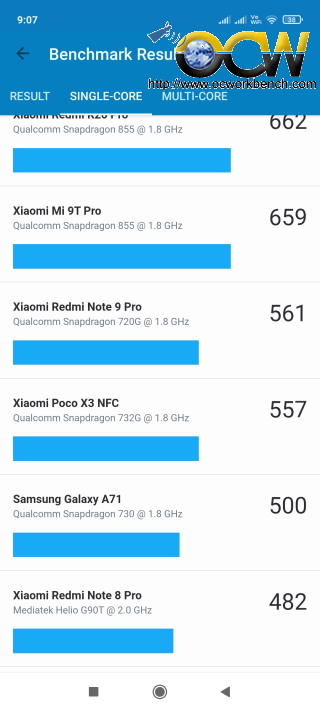
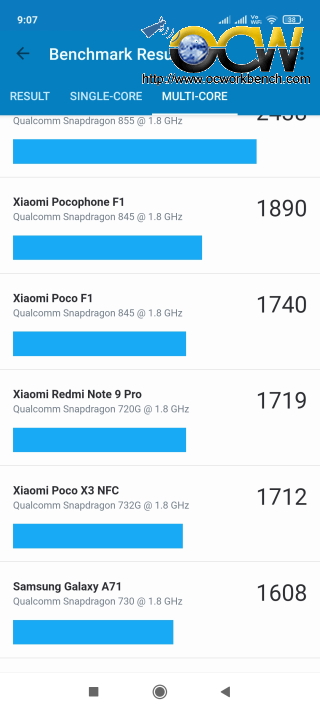
Geekbench 5
From the benchmarks, the performance of the Dimensity 700 is close to the Snapdragon 732G
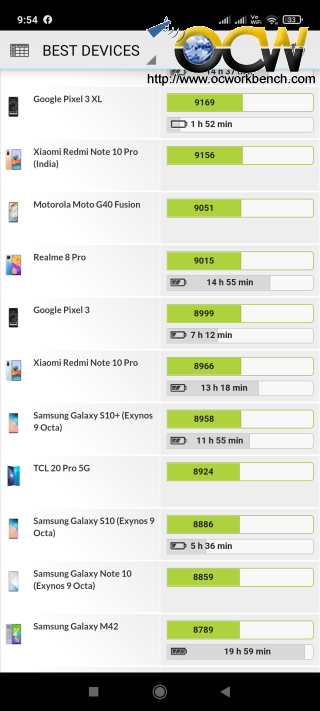
PCMARK Work 3 performance
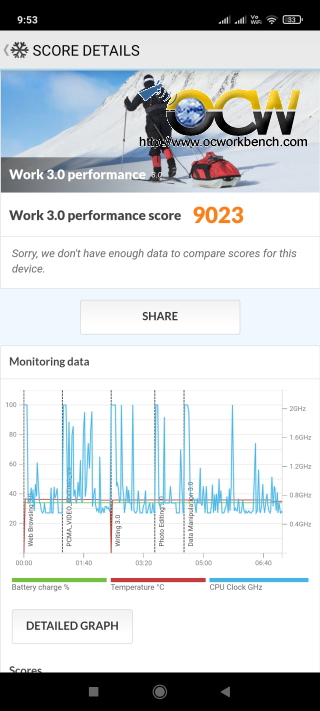
Using PCMark as a gauge, the performance should be around that of a Galaxy S10 or a Snapdragon 845 on the Pixel 3.
[nextpage title=”Photos taken with camera”]
The POCO M3 Pro 5G uses a 48 MP sensor from OmniVision (ov48b) at f/1.79. The 48 MP is 1/2 inch sensor which helps to capture more light. Photos taken are in 12 MP unless 48 MP is selected.
There is also a 2 MP macro camera at f/2.4 with 2 MP depth sensor which takes close up shots when selected. Below is the user interface.

So, will it be able to do well in low light shots? Let’s take a few shots taken in night mode.


The shots in Night mode appears a bit overly sharpen, colours are over saturated. The original photo which was taken in normal mode appears a bit duller. Surprisingly, the same shot taken in 48 MP mode appears on par with Night mode.
The Pixel 3 XL photo has cooler colours while the ones taken by the POCO are warmer.


Let’s take a look at one of the macro shots vs normal shot. With macro shot, the object can be as close as 4 to 5 cm whereas you would normally need to use digital zoom in normal mode to get close to the letterings on the adapter as shown in the picture below – Macro shot (left) vs Normal shot (right)


[nextpage title=”Video Recording in 1080p”]
Stabilisation is an important aspect of video recording.
The Poco M3 Pro 5G supports video recording at up to 1080 at 30 fps with it’s main camera and up to 720p at 30 fps with it’s macro camera. No 4K mode is available. There is probably no OIS.
Here is a video we took and compared it with the Google Pixel 3 XL.
We noticed that the reproduction of colours of the POCO M3 Pro 5G to be pretty good. In terms of the stability, the lack of OIS might need to be compensated with a gimbal.
[nextpage title=”5G connection”]
As the POCO M3 Pro 5G supports NSA (and SA in future), we tested the phone with the latest MVNO – Gorilla Mobile. To our surprise, it can actually connect to M1’s 5G NSA network.
.
.
.
.
.
Here is our youtube video of the speedtest.
[nextpage title=”Conclusion”]
It has been sometime since we last reviewed an entry-mid range smartphone. Our experience with the POCO M3 Pro 5G based on the Mediatek Dimensity 700 is an eye opener for us. If you go into discussion groups, most people will discourage purchasing mediatek based smartphones, claiming that it overheats.
To our surprise, the temperature under intense gaming did not even go beyond 42 deg C while playing Need For Speed. Likewise, running demanding benchmarking tools didn’t push it beyond that temperature too.
Performance wise, the phone based on the Dimensity 700 is not as fast as the high end processors but is definitely comparable to a Snapdragon 845. As we are using 2 SIMs running one in 4G while in 5G, the chipset supports both dual 5G connectivity.
Design wise, we are fine with the plastic back plate The 90 Hz screen is pretty smooth while browsing. Throw in with NFC and FM Radio, this makes the smartphone an almost all rounder for the every user.
Surprise your friends with the impressive night shots from the phone. The back 1/2 inch sensor seems to be able to take wonderful night shots (in night mode) with lots of light. The photos taken in night mode is pretty good as compared to those taken using Gcam. The only thing is that some colours may be a bit over saturated and there is no differentiation of colour shades. There is no wide angle or optical zoom available.
In Conclusion, I think for the price of S$339, the POCO M3 Pro 5G is really a steal. If you intend to purchase a future proof phone, look no further. As for 5G SA support, it is still an unknown as it is more dependent on the telcos if they want to provision it to work on their networks.
OCWorkbench highly recommends the POCO M3 Pro 5G as your first 5G capable phone for those who want a taste of 5G speeds in the near future.
Pros :
- Dual 5G sim slot
- 5G NSA/NA bands
- NFC
- FM Radio
Cons:
- Mono Speaker
- No wide angle camera
Ratings
- Performance 8
- Design 9
- Features 8
- Usability 9
- Value for money 10
- Score : 8.8 / 10
