

7 Jan 2021
In 2019, we reviewed the Gigabyte AORUS NVME Gen 4 2 TB SSD (based on Phison chipset) on AMD X570 chipset motherboard. We have seen that with the performance of PCIe Gen 4 SSD when it is paired up with a motherboard that supports PCIe 4.0 and PCIe 3.0.

Samsung launched it’s 980 Pro series which puts up a strong fight against M.2 (based on the Phison chipset). Powered by a new Elpsis controller designed to harmonize the flash memory components and the interface for superior speed – with a PCIe 4.0 interface that’s 2x faster than PCIe 3.0 SSDs and 12x faster than Samsung SATA SSDs. Samsung claims that it can get read speeds up to 6,400 MB/s with 980 PRO with it’s Samsung V-NAND 3-bit MLC storage memory and a 1 GB DDR4 SDRAM cache.
The package is simple as it is – a light weight 9 grams M.2 (2280) model MZ-V8P500, 500 GB PCIe 4.0 NVMe M.2. It has a Dimension (WxHxD)
of 80.15 x 22.15 x 2.38 (mm). It does not come with a heatsink.

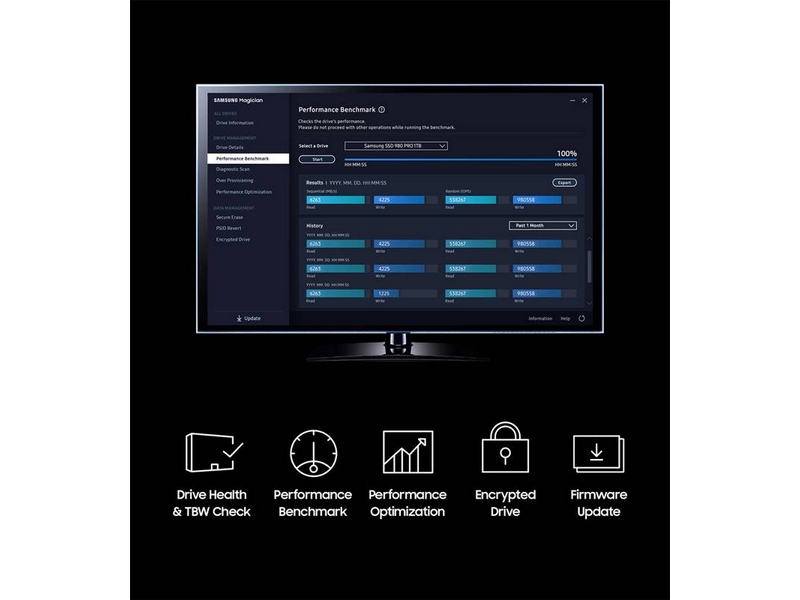
Unlock the full potential of 980 PRO with Samsung Magician’s advanced, yet intuitive optimization tools. Monitor drive health, optimize performance, protect valuable data, and receive important updates with Magician to ensure you’re always getting the best performance out of your SSD.
In the next page, we take a look at the benchmarks with CrystaldiskMark and SiSoft Sandra.
[nextpage title=”Benchmarks – CrystalDiskMark”]
Tested on a X570 AORUS MASTER motherboard (Samsung). The result is presented below:
It can be easily seen that the Samsung 980 Pro leads in Sequential Read reaching almost 7000MB/s, a 2000 MB/s lead. In terms of write, it is also faster than the AORUS NVME we tested before which scores around 5000MB/s for Read and 4200MB/s for write, the typical results of a Phison chip NVme.


[nextpage title=”File System Bandwidth – SiSoft Sandra 2019″]
In terms of file system bandwidth, the Samsung leads by 29% but it has a smaller bandwidth for sequential write.
| Samsung 980 Pro | AORUS NVMe | |
| Drive Score | 4.1 GB/s | 3.16 GB/s |
| Sequential Read Bandwidth | 6.11 GB/s | 2.8GB/s |
| Sequential Write Bandwidth | 2.16 GB/s | 4 GB/s |


[nextpage title=”File System I/O – SiSoft Sandra 2019″]
Device Score for the AORUS NVmE is 44.3kIOPS while the Samsung 980 Pro is at 54.4kIOPS – a 22% difference.


[nextpage title=”Conclusion”]
AMD users probably already have PCIe 4.0 on their boards but were turned off with the high price of PCIe 4.0 NVMe. Things are going to change with Intel joining the PCie 4.0 bandwagon with it’s Z590 chipset.
Currently, there are a few PCIe 4.0 NVMe available in the market. The Samsung 980 Pro 250GB PCIe NVMe Gen4 SSD M.2 (MZ-V8P500) is around USD 89.99. The 500 GB version retails at USD 139.99
Other models of Gen 4 NVMe are the Sabrent Rocket NVMe Gen 4 and WD Black SN850 Gaming SSD.
The Sabrent Rocket NVMe Gen 4 looks way cheaper as you can get a 500 GB for the same price of USD 89.99. Although it runs on Gen 4, it supports speeds of up to 5000 MB/s (read) and 2500 MB/s (write).
WD Black SN850 Gaming SSD is another contender. The 500 GB retails at USD 119 and it offers speeds up to 7000/5300MB/s.
In terms of price, the Samsung (for the 500 GB) is a bit more expensive as compared to the closest competitor the WD Black SN850 Gaming SSD. * Prices quoted are from Amazon.com
If you are on the budget, the slower Sabrent Rocket NVMe could be a good choice as it provides a better dollar per gigabyte.
In terms of warranty, all manufacturer provides 5 years limited warranty (check their respective sites for details).
In Conclusion, NVMe performance is so fast that you probably even notice it. The choice is yours if you need a larger capacity or higher pricing for faster speeds. What would be your choice ?
I give the Samsung 980 Pro 250GB PCIe NVMe Gen4 SSD M.2 our editors choice award.
