
SIMBA Telecom appears to have taken another important step in its 5G journey by activating its 5G Standalone (SA) network on the 2100 MHz (n1) spectrum band. While the deployment has not been accompanied by a detailed public announcement, network scans and user observations indicate that SIMBA’s SA core is now live, marking a significant milestone in the operator’s network evolution. The discovery was made by enthusiasts that tested in Kovan, Hougang Ave 7, KPE, Orchard, Little India etc. Currently, the operator is still running both n1 SA and B8/B40+n1 NSA concurrently.
What is 5G Standalone?
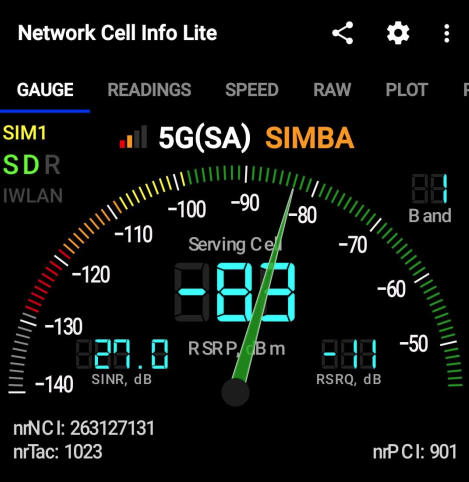
Unlike Non-Standalone (NSA) 5G, which relies on an existing LTE core network, 5G Standalone operates on a dedicated 5G core. This architecture unlocks features such as:
- Lower network latency
- Faster connection setup
- Improved network slicing
- Better support for Voice over New Radio (VoNR)
- Enhanced support for future IoT and enterprise applications
For operators, moving to SA represents the true realization of 5G technology rather than simply adding faster radio access to a 4G backbone.
Running on a 10 MHz n1 Carrier
The most interesting aspect of SIMBA’s deployment is that it appears to be using a single 10 MHz carrier in the n1 (2100 MHz) band for its Standalone service. This is probably the first in the world as they were not awarded the n78 band of 100 MHz. This gives them a disadvantage in speed as the bandwidth is 10x smaller.
Compared with larger operators that deploy much wider 5G channels—often 40 MHz, 60 MHz, or even 100 MHz in the 3.5 GHz band—a 10 MHz carrier offers significantly lower capacity. However, it is still sufficient to deliver:
- Dedicated 5G SA connectivity
- Lower latency compared to NSA
- Native 5G core services
- Future VoNR capability
This makes the deployment technically significant even if peak throughput is lower than competing networks.
Why n1?
The n1 band offers several advantages for SIMBA:
- Good balance between coverage and capacity.
- Existing nationwide infrastructure operating around the 2100 MHz frequency.
- Better indoor penetration than higher-frequency mid-band spectrum.
- Ability to reuse existing radio equipment with software upgrades.
Although the bandwidth is relatively narrow, the spectrum provides broad coverage, making it a practical choice for launching nationwide Standalone services.
Capacity Will Be the Main Challenge
The primary limitation is spectrum.
A single 10 MHz 5G carrier provides considerably less capacity than the large contiguous spectrum holdings available to Singapore’s larger mobile operators. As subscriber numbers grow, congestion may become noticeable during peak periods unless additional spectrum becomes available or traffic is efficiently balanced across LTE and 5G layers.
What Users Can Expect
For many subscribers, the immediate experience may not look dramatically different.
Typical improvements include:
- More consistent 5G connections
- Reduced latency
- Better network responsiveness
- Improved readiness for future VoNR services
Peak download speeds, however, will largely depend on available spectrum and network load rather than simply whether the device is connected to Standalone 5G.
Users will also need a compatible 5G device with SA support and appropriate network settings enabled to access the service. SIMBA provides guidance on device compatibility and 5G configuration through its customer support resources.
Looking Ahead
SIMBA has steadily expanded its 5G footprint since launching commercial 5G services, with coverage continuing to improve over time. The apparent activation of its Standalone network represents another important milestone, demonstrating that the operator is moving beyond transitional NSA deployments toward a fully cloud-native 5G architecture.
While a 10 MHz n1 deployment may not compete with wider-band implementations in terms of raw speed, it establishes the technological foundation for future services and positions SIMBA to introduce additional 5G capabilities as spectrum and infrastructure evolve.
For Singapore’s mobile market, the move reinforces that all four mobile operators are now progressing toward mature 5G Standalone networks, paving the way for the next generation of mobile connectivity.